 Best of Sarasota 2026 Gold

How Does Botox Work? The Science and History of Wrinkle Relaxers
Medically reviewed


In the 1980s, an eye doctor in Vancouver was using a new medicine to calm a person’s eyelid spasms. Then she noticed something nobody expected. The frown lines between that person’s brows had softened. Her husband, a dermatologist, tried it on their office assistant. The assistant became the first known person treated for frown lines. That happy accident also explains the question we hear every week: why do results wear off? The answer starts with how a wrinkle relaxer works.

How do wrinkle relaxers work?
Wrinkle relaxers work by quieting the signal that tells a muscle to tighten. Every expression starts with a nerve. When you frown, smile or raise your brows, a nerve sends a signal to a small muscle in your face, and the muscle contracts.
That signal is carried by a chemical messenger called acetylcholine. The nerve ending releases it, and the muscle responds. A wrinkle relaxer blocks that release in the muscle where it is placed.
With less signal, the muscle tightens less. The skin above it is not folded as often or as hard, so the line it makes softens.
The medicine works where it is placed. Your provider chooses which muscles to treat and how much movement to keep. That is why a good result can look rested, not frozen.
Why do wrinkle relaxer results wear off?
Results wear off because the nerve heals, not because your body “burns through” the treatment. A wrinkle relaxer is temporary by design.
Over time, the nerve grows tiny new branches and repairs its connection to the muscle. Lab research shows this happens in two steps. First, the new branches take over and carry the signal. Later, the original nerve ending recovers, and the extra branches fade away. As the connection returns, so does movement.
That is the science behind the timeline. For most people, results last two to four months, often about 90 days, and it depends on the person.
Several things shape how long your results last:
- The medication. Each wrinkle relaxer works a little differently.
- The dose. How much is placed in each area.
- Placement. Which muscles are treated.
- Muscle strength. How strong the treated muscles are.
- Movement. How much you use those muscles every day.
No two faces wear off on the same clock. That is not a flaw. It is why we take the time to learn how your face moves, then plan your dose and your next visit around you.
Where did wrinkle relaxers come from?
Wrinkle relaxers began with the study of a poison, about 200 years ago. Here is how a feared toxin became a precise medical treatment, in five moments.
- 1820s: a doctor studies a poison. A German doctor studied a poison found in spoiled sausage. The name botulinum comes from the Latin word for sausage. He noticed that the poison quieted the nerves that move muscles. He even wondered whether it might someday be useful as a medicine. In 1895, a scientist in Belgium identified the bacterium that makes it.
- 1980: an eye doctor finds a use. A San Francisco eye doctor showed that tiny doses could straighten crossed eyes. The medicine relaxed the eye muscle that pulled too hard, as an alternative to surgery.
- 1989: the first FDA approval. The FDA approved it for crossed eyes and eyelid spasms.
- 1992: the Vancouver discovery. The couple from our story published the first report on treating frown lines.
- 2002: approved for frown lines. The FDA approved it for frown lines.
Today, wrinkle relaxers are among the most popular nonsurgical cosmetic treatments in the world.
Notice the pattern. Each step came from careful observation. Doctors saw what the toxin did to nerves and muscles. Then they learned to use tiny, measured amounts in exactly the right place.
How did a poison become a precise medicine?
It became a medicine through purification and careful measurement. The wrinkle relaxers we use today are purified, precisely measured prescription medications.
In nature, the toxin is dangerous. In medicine, what matters is purity, the amount and where it goes. A trained provider places very small amounts in chosen muscles to get a specific effect.
Because these are prescription medications, the visit is medical care. That means a health history, an assessment and a licensed provider working under a board-certified medical director.
What can you expect after a treatment?
You can expect a gradual change, not an overnight one. Here is a typical timeline:
- Days 3 to 7: you start to notice a change.
- About two weeks: full results.
- The weeks after: smooth, natural movement.
- Later: movement slowly returns, and it is time to plan your next visit.
Because full results take about two weeks, give yourself time before a big event. Our guide on how far ahead to book before an event gives the timing for each kind of treatment.
Which lines do wrinkle relaxers help most?
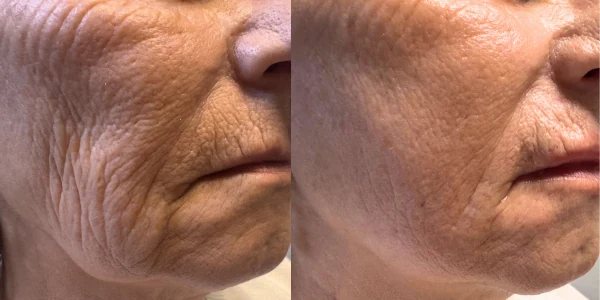
Wrinkle relaxers help most with lines caused by movement. These are called dynamic lines. Frown lines between the brows, forehead lines and crow’s feet are common examples.
Lines that stay when your face is still are different. They are called static lines. Over years of repeated movement, and as skin loses some of its firmness, a line can stay visible even at rest.
Those lines may also need dermal filler or a collagen treatment such as microneedling. Our three-line test explains how to tell which kind of line you have.
Does a steady schedule make a difference?
Yes, a steady schedule helps. Treatment about every three months keeps movement softer. Over repeated treatments, lines at rest can keep softening too.
If you decide to stop, movement returns gradually. Your lines return to where they would have been. Stopping does not make you age faster.
Are all wrinkle relaxers the same?
No, each wrinkle relaxer works a little differently. They share the same type of active ingredient, but each is made by a different company with its own process.
At Eternal MedSpa, we carry five wrinkle relaxers. We will help you choose the one that fits your face, your goals and your schedule. Tell us what you want to soften and what you want to keep, and we will plan the right product, amount and schedule for you.
How Botox works: common questions.
How long does Botox last?
For most people, Botox and other wrinkle relaxers last two to four months, often about 90 days, and it depends on the person. The medication, the dose, where it is placed and how strong your muscles are all play a part.
Why does Botox wear off?
Botox wears off because the nerve heals, not because your body burns through the medicine. Over time, the nerve grows tiny new branches and repairs its connection to the muscle, and movement returns.
How long does Botox take to work?
Most people start to notice a change within three to seven days. Full results show at about two weeks.
What happens if I stop getting Botox?
Movement returns gradually, and your lines return to where they would have been. Stopping does not make you age faster.
Is Botox used for anything besides wrinkles?
Yes, the same family of medications is approved for chronic migraine, heavy sweating and certain muscle spasms. Your provider can tell you which uses apply to you.
Who discovered that Botox smooths wrinkles?
A husband-and-wife team in Vancouver, an eye doctor and a dermatologist, noticed the effect in the 1980s. They published the first report on treating frown lines in 1992.
Sources.
- Erbguth FJ. Historical notes on botulism, Clostridium botulinum, botulinum toxin, and the idea of the therapeutic use of the toxin. Movement Disorders. 2004.
- Scott AB. Botulinum toxin injection into extraocular muscles as an alternative to strabismus surgery. Ophthalmology. 1980.
- Carruthers JD, Carruthers JA. Treatment of glabellar frown lines with C. botulinum-A exotoxin. Journal of Dermatologic Surgery and Oncology. 1992.
- de Paiva A, Meunier FA, Molgó J, Aoki KR, Dolly JO. Functional repair of motor endplates after botulinum neurotoxin type A poisoning: biphasic switch of synaptic activity between nerve sprouts and their parent terminals. Proceedings of the National Academy of Sciences. 1999.
More articles. From our Knowledge Center.

Book your consultation.
Every plan starts with a complimentary consultation.
Reserve your visit in Sarasota or Venice. Prefer to text first? Text us at 941-337-8461.
Still deciding? Try the Eternal Plan Builder.
Please give 24 hours' notice to cancel or reschedule. Cancellation policy
Educational content only. This article does not diagnose, prescribe, determine candidacy, or replace evaluation by an appropriately licensed healthcare provider. Treatment plans depend on health history, goals, and provider assessment. Individual results vary.