 Best of Sarasota 2026 Gold

What Is the Difference Between Biostimulators and Dermal Fillers?
Medically reviewed


Biostimulators and fillers come up in the same conversation so often that many people assume they are the same thing with different brand names. They are not. A hyaluronic acid filler replaces volume directly. A biostimulator like Radiesse gives some lift right away, then asks your body to rebuild support on its own. That difference shapes how each one is used, where it goes, and how a plan comes together.
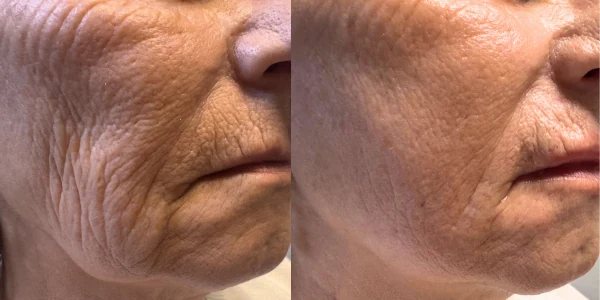
What is the difference between a filler and a biostimulator?
The difference is how each one creates volume. A hyaluronic acid (HA) filler fills space. A biostimulator like Radiesse fills space at first and then prompts your body to make new collagen.
Both are injected to restore volume that has been lost. Both get called “filler” in everyday talk. From there, it is a short step to thinking they can be swapped for each other. But they work in different ways, and that changes what belongs in a treatment plan.
At Eternal MedSpa, our HA fillers include RHA, our go-to for expressive areas, along with Restylane and Juvéderm. Radiesse is our primary biostimulator. You can see every product we use on our dermal filler page.
Why does the face lose volume in the first place?
The face loses volume because the layers under the skin change with age, not just the skin itself. Knowing which layer changed helps explain why one tool fits one area and another tool fits a different area.
Your face holds fat in separate pockets, called fat compartments. Over time, some of these pockets shrink or shift, and they do not all age the same way. (Rohrich and Pessa, 2007.)
The bones of the face change too. Parts of the upper jaw, the rim around the eye socket and the lower jaw can slowly lose bone with age. The fat and skin above them then have less to rest on. (Mendelson and Wong, 2012.)
That is why a careful assessment looks at where support has truly been lost, not just where volume looks low. A hollow can come from a shrinking fat pad, a change in the bone underneath, or both.
How does hyaluronic acid filler work?
HA filler works by taking up space. Once it is placed in a targeted area, it adds volume right away.
Hyaluronic acid is a sugar molecule your skin makes on its own. It holds water and helps keep skin plump. Your body breaks down its own HA quickly. Filler HA is cross-linked, which means its long chains are chemically joined into a gel. That gel resists breakdown, so it lasts much longer than your skin’s natural HA. (Tezel and Fredrickson, 2008.)
Over about six months to a year or more, depending on the product and the area, your body slowly breaks the gel down. As it does, the volume fades.
HA filler has one more feature that matters a great deal: it can usually be dissolved. An enzyme called hyaluronidase cuts HA into small pieces that your body clears. If a result ever needs softening, your provider has a way to do that.
How does a biostimulator like Radiesse work?
Radiesse works in two stages: it lifts right away, and then it helps your body build new support over the months that follow.
Radiesse is made of tiny microspheres of calcium hydroxylapatite (CaHA), a mineral compound, held in a soft gel. The gel gives an immediate lift, much like an HA filler.
Over time, your body absorbs the gel. The microspheres stay behind in the tissue. There, they activate fibroblasts, the cells that make collagen. Those cells lay down new collagen and elastin for months afterward. Collagen gives skin its firmness. Elastin helps it stretch and spring back.
That is the “bio” in biostimulator. In one small study, tissue samples taken after a CaHA treatment showed new collagen forming around the microspheres over the long term. (Berlin and colleagues, 2008.)
Because your own tissue keeps responding, results tend to last longer. They commonly last a year or more, and some studies have followed improvement out to about two years. How long results last depends on the person.
Can Radiesse be dissolved like HA filler?
No. Radiesse is not hyaluronic acid, so the enzyme that dissolves HA filler does not work on it, and there is no simple way to remove it.
This is one more reason the choice is made with a provider, not by asking for a product by name. Placement is planned with care from the start.
What is each one good at?
HA filler is good at precise, reversible volume. Radiesse is good at broad structural support that keeps building.
- HA filler (RHA, Restylane, Juvéderm): targeted volume in areas that move, such as the lips, under-eye hollows and expressive contours. RHA is built to hold up in areas of movement. Restylane and Juvéderm are used for other precise corrections. HA filler can be dissolved if needed.
- Radiesse: broader structural volume loss, such as the cheeks, temples and jawline. The goal is a visible lift now and collagen support that keeps building for months.
Under the eyes, we are conservative. Hollows, puffiness, pigment and cheek support all play a part, so that area always starts with a consultation.
Why do many plans use both?
Many plans use both because each tool does a different job well. It is not a choice between competing products.
A common plan might use Radiesse for broad support in the cheeks or along the jaw, and RHA for precise, expressive areas such as the lips. The two are sequenced on purpose, not all done at once.
Structure is the framework everything else is built on. Getting it right, with the right tool in the right order, is what helps the rest of a plan hold up over time.
How does your provider choose the right tool?
Your provider chooses by looking at where your face has changed, how each area moves, and what timeline makes sense for you. It is not a menu choice.
At Eternal MedSpa, Antje Dangel, PA-C, and Jennifer Demers, PA-C, start with a structural assessment. They look at where support has truly been lost, which areas move the most, and how you want the result to look and feel. Then they explain which tool fits each area, and why.
A few questions to bring to your consultation:
- Is my concern volume loss, loss of support, or both?
- Which areas need structure, and which need precise detail?
- Would a biostimulator, an HA filler, or both fit my goals?
- What order of treatment makes sense for me, and why?
Injectable treatments carry risks. They should only be done after a clinical assessment by a qualified provider. Results vary.
Biostimulators and fillers: common questions.
Is Radiesse a filler or a biostimulator?
Radiesse is both. Its gel adds volume right away like a filler, and its calcium hydroxylapatite microspheres prompt your body to make new collagen and elastin over the months that follow.
How long does HA filler last compared with Radiesse?
HA filler usually fades over about six months to a year or more, depending on the product and the area. Radiesse results commonly last a year or more, and some studies have followed improvement out to about two years. How long either one lasts depends on the person.
Can a biostimulator like Radiesse be dissolved?
No. Radiesse cannot be dissolved with the enzyme used for HA filler, which is why placement is planned with care from the start.
Which is used for lips, HA filler or Radiesse?
HA filler is the tool used for lips, because it is precise, holds up in an area that moves, and can be dissolved if needed. Your provider will talk through what fits your lips at your consultation.
Do I have to choose between a biostimulator and a filler?
No. Many guests benefit from both, each used for what it does well and sequenced on purpose rather than all at once.
Sources.
- Rohrich RJ, Pessa JE. The fat compartments of the face: anatomy and clinical implications for cosmetic surgery. Plastic and Reconstructive Surgery. 2007.
- Mendelson B, Wong CH. Changes in the facial skeleton with aging: implications and clinical applications in facial rejuvenation. Aesthetic Plastic Surgery. 2012.
- Tezel A, Fredrickson GH. The science of hyaluronic acid dermal fillers. Journal of Cosmetic and Laser Therapy. 2008.
- Berlin AL, Hussain M, Goldberg DJ. Calcium hydroxylapatite filler for facial rejuvenation: a histologic and immunohistochemical analysis. Dermatologic Surgery. 2008.
More articles. From our Knowledge Center.


Book your consultation.
Every plan starts with a complimentary consultation.
Reserve your visit in Sarasota or Venice. Prefer to text first? Text us at 941-337-8461.
Still deciding? Try the Eternal Plan Builder.
Please give 24 hours' notice to cancel or reschedule. Cancellation policy
Educational content only. This article does not diagnose, prescribe, determine candidacy, or replace evaluation by an appropriately licensed healthcare provider. Treatment plans depend on health history, goals, and provider assessment. Individual results vary.