 Best of Sarasota 2026 Gold

How Do Hormones Affect Your Skin? Collagen Loss in Women and Men
Medically reviewed


Women tell us, “My skin changed almost overnight.” Men tell us, “I just don’t feel like myself.” Different words. Often the same root: hormones. For women, the change is a cliff. For men, it is a slope. Both can show up in the mirror, in your energy and in your sleep. Here is what is happening, why it is not “just aging,” and what thoughtful hormone care looks like.

What does estrogen do for your skin?
Estrogen helps your skin make collagen and hold water.
Collagen gives skin its firmness and smooth texture. It is the support layer under the surface. Your skin keeps making and replacing it, and estrogen is one of the signals that helps that work along.
Testosterone has a different main job. It supports muscle, energy and drive. When either hormone falls, you often feel it before you see it.
Why do women’s skin changes feel so sudden?
Because estrogen drops at menopause, and skin collagen drops with it, fast.
In the years before menopause, estrogen rises and falls unevenly. After menopause, it drops. The skin responds quickly:
- The first five years: as much as 30% of skin collagen can be lost.
- The first 15 years: the average loss is about 2% a year.
Most of the loss is packed into those first few years. That is the cliff. It is why so many women say their skin changed almost overnight.
Research ties this collagen loss to the drop in estrogen, not only to the passing years. That is the key reason it is not “just aging.” There is a specific cause behind it.
What you may notice:
- Drier skin
- Thinner skin
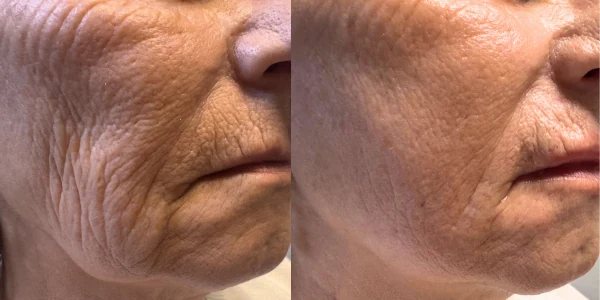
- Crepey texture
- Hot flashes and night sweats
- Poor sleep
- Mood changes
What happens to testosterone as men age?
For men, testosterone usually slides a little each year instead of dropping all at once.
The Massachusetts Male Aging Study followed more than 1,000 men, ages 40 to 70, for about a decade. In that time, their usable testosterone fell 2 to 3% a year.
“Usable” means the part of testosterone in the blood that is not tightly bound to a protein, so the body can put it to work. In the same study, total testosterone fell more slowly, about 1.6% a year. So the part the body can use fell faster than the total.
There is no single drop to notice. It just slides. Year after year, it adds up. That is the slope.
What you may notice:
- Lower energy and drive
- Less muscle
- More belly fat
- Slower recovery
Could it be something other than hormones?
Yes. Low energy, low drive, poor sleep and mood changes can have many causes, which is why an evaluation comes first.
For men, labs come first. Expert guidelines say low testosterone should be diagnosed only when a man has symptoms and levels that are consistently low, confirmed with repeat morning blood tests. That is why men require labs before treatment. Recent labs can be used.
For women, labs depend on health history. If labs would help, your provider orders them.
Many people are told their labs look “normal” while they still feel off. Lab values are only one part of the picture. Your symptoms, your health history and your goals matter too.
Can hormone therapy help your skin?
Estrogen therapy can raise skin collagen after menopause, but hormones are never prescribed for skin alone.
Hormone therapy is a medical decision. It is made for your symptoms and your health, and it has risks as well as benefits. Skin is never the reason on its own.
For the skin itself, women and men can add treatments focused on collagen support:
- Microneedling creates tiny, controlled channels in the skin to support collagen remodeling.
- Laser uses controlled heat that may support collagen and skin quality over a series.
- Medical-grade skin care protects the collagen you have between visits.
What are the risks of hormone therapy?
Hormone therapy has risks as well as benefits, and it is not right for everyone.
- For men: testosterone can lower fertility. It can also raise red blood cell count and blood pressure, so these are checked during care. If you may want children, tell your provider before you start.
- For women: whether the benefits outweigh the risks depends on your age, your health history and how long it has been since your last period.
That is why evaluation, follow-up and, when needed, labs are part of every plan. If hormone therapy is not right for you, we will tell you.
What does good hormone care look like?
Good hormone care starts in person, uses a dose built for you, and keeps checking in as your body changes.
Many OB/GYNs and primary care doctors treat hormones as one part of a broad practice. We built our bioidentical hormone restoration program around specialists who focus on hormones every day:
- We see you first. Your care starts with a complimentary consultation and evaluation, face to face, with Antje or Jenn. We review your symptoms, your health history, your goals, and whether hormones make sense for you. If you need labs, we order them.
- Specialists review your case. Our partner network, BRITE, then reviews your case. Its prescribers do one thing: hormone restoration for menopause and andropause, the gradual drop in testosterone in men.
- A dose built for you. The program follows the Rosensweet Method, developed over more than 30 years. Bioidentical hormones go on the skin, so your dose can change as you respond. It is not a pellet program. A pellet, once placed, cannot be adjusted.
- Two layers of care. Your BRITE specialist manages your prescription. Our team keeps monitoring you in the clinic, under a board-certified medical director. Most plans are fine-tuned in the first few months, and we keep adjusting as your body changes.
The goals we hear most are better sleep, steady energy, a clearer head, a stronger drive, and skin that looks like you again. Our job is to find out whether hormones are part of getting there.
Hormones and skin: common questions.
Do hormones affect skin collagen?
Yes. Estrogen helps skin make collagen and hold water, and as much as 30% of skin collagen can be lost in the first five years after menopause.
Is low testosterone just part of aging?
Not always. Testosterone often slides slowly with age, but low energy, low drive and less muscle can have other causes, so expert guidelines call for symptoms plus consistently low levels on repeat morning blood tests before a diagnosis.
Will hormone therapy help my skin?
Estrogen therapy can raise skin collagen after menopause, but hormones are never prescribed for skin alone. For the skin itself, microneedling, laser and medical-grade skin care focus on collagen support.
Is your hormone program a pellet program?
No. Our program uses bioidentical hormones applied to the skin, so your dose can be adjusted as you respond.
Do I need labs before hormone therapy?
Men require labs before treatment, and recent labs can be used. For women, labs depend on health history, and your provider orders them when they would help.
Is hormone therapy right for everyone?
No. It has risks as well as benefits, and your provider reviews them with you; if it is not right for you, we will tell you.
Sources.
- Calleja-Agius J, Muscat-Baron Y, Brincat MP. Skin ageing. Menopause International. 2007.
- Feldman HA, Longcope C, Derby CA, et al. Age trends in the level of serum testosterone and other hormones in middle-aged men: longitudinal results from the Massachusetts Male Aging Study. Journal of Clinical Endocrinology & Metabolism. 2002.
- Bhasin S, Brito JP, Cunningham GR, et al. Testosterone therapy in men with hypogonadism: an Endocrine Society clinical practice guideline. Journal of Clinical Endocrinology & Metabolism. 2018.
More articles. From our Knowledge Center.

Book your consultation.
Every plan starts with a complimentary consultation.
Reserve your visit in Sarasota or Venice. Prefer to text first? Text us at 941-337-8461.
Still deciding? Try the Eternal Plan Builder.
Please give 24 hours' notice to cancel or reschedule. Cancellation policy
Educational content only. This article does not diagnose, prescribe, determine candidacy, or replace evaluation by an appropriately licensed healthcare provider. Treatment plans depend on health history, goals, and provider assessment. Individual results vary.