 Best of Sarasota 2026 Gold

What Does Red Light Therapy Actually Do for Your Skin?
Medically reviewed


Red light therapy is a gentle, well-studied way to support your skin. It uses light-emitting diodes, or LEDs, to shine specific colors of light onto the skin. Red light does not heat or injure the skin. It contains no ultraviolet (UV) light, so it does not tan or burn. It works slowly and needs regular use. It does not replace treatments that do bigger jobs. It helps most as a steady habit alongside them.
Red light masks: do they work?
Red light masks are everywhere now. Guests ask us about them almost every week. Do they work? Are they safe? Do they replace a facial, a laser, or microneedling?
The short answer: red light is a gentle, well-studied way to support your skin. It works slowly and needs regular use. It does not replace treatments that do bigger jobs. It helps most as a steady habit alongside them.
Here is what the light does, what the research shows, and where it fits.
Where did red light therapy come from?
The story starts with plants and space.
In the 1990s, a Wisconsin company built small, lightweight LED lights for plant-growth experiments with NASA. A doctor at the Medical College of Wisconsin, Dr. Harry Whelan, noticed that the same light seemed to help human cells heal. In lab tests, cells exposed to the light grew faster than cells that were not.
Navy doctors then tried the lights. In a 2000 NASA report, they said cuts on a submarine crew healed in about seven days with the light, compared with 14 days without it. Those early reports were small and not fully controlled. But they started decades of research into how light affects skin.
How does red light work in the skin?
Red light therapy uses light-emitting diodes, or LEDs, to shine specific colors of light onto the skin. The research name for this is photobiomodulation: using light to change how cells behave.
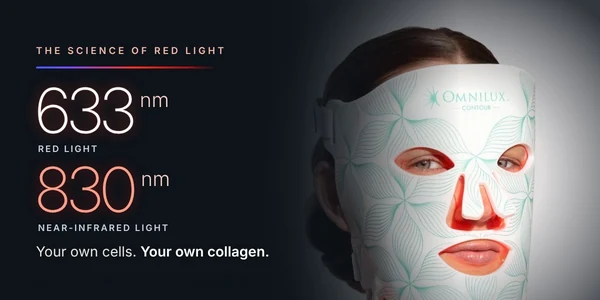
Most LED masks for aging skin, including the Omnilux Contour Face, use two kinds of light.
Red light, at about 633 nanometers. A nanometer is a way to measure the color (wavelength) of light. Red light works in the upper layers of the skin, where tone and fine lines show.
Near-infrared light, at about 830 nanometers. This is just past what the human eye can see. Longer wavelengths reach deeper into the skin.
Some LED devices for acne also use blue light, at about 415 nanometers.
Color sets the depth
The color of light decides how deep it goes. Shorter wavelengths, like blue, stay near the surface, where acne bacteria live. Red light reaches the dermis, the layer under the surface where your collagen-making cells live. Near-infrared light goes deeper still. That is why devices for acne use blue light, and devices for lines and firmness use red and near-infrared.
Your cells have a light sensor
Mitochondria are the small parts of each cell that make energy. An enzyme inside them, called cytochrome c oxidase, absorbs red and near-infrared light. The leading theory is that the light frees this enzyme from nitric oxide, a molecule that slows it down. The cell can then make more energy, in a form called ATP.
Energy becomes repair
With more energy, fibroblasts, the cells that build collagen, may work more actively. Collagen is the protein that keeps skin firm and smooth. The light may also help calm inflammation.
More is not better
Light works on a curve, which scientists call a biphasic dose response. Too little light does nothing. The right amount helps. Too much can cancel the benefit. That is why sessions are short and timed, and why steady use over weeks matters more than long sessions.
How is red light different from a laser or microneedling?
This is the most important thing to understand.
Many collagen treatments work by controlled injury. Microneedling makes tiny channels in the skin. A laser uses heat. Your body sees that small, careful injury and rebuilds the skin with new collagen. That is a strong signal, and it usually comes with some redness or downtime.
Red light does not heat or injure the skin. It contains no ultraviolet (UV) light, so it does not tan or burn. It gives your cells a steady nudge instead of a big push.
That is why red light has little to no downtime, needs many sessions over several weeks to show a change, and pairs well with injury-based treatments but cannot replace them.
Why does red light fit a natural approach to aesthetics?
Many of our guests come to us for the same reason. They want to look healthy and natural, never overdone. They want to look refreshed and still look like themselves.
Red light is one of the most natural fits for that goal. It adds nothing to your skin. There is no needle, no heat, no injected product, and no UV light. It works by helping your own cells make more of your own collagen.
Many of the treatments we build plans around follow the same idea: prompt the skin to rebuild itself. SkinPen microneedling uses tiny, controlled channels. Radiesse adds support right away and may also help your skin build its own collagen over time. Red light is the gentlest version of that idea: a small, steady nudge you can give your skin at home, between visits.
It is also one of Jenn's personal favorites, and one she uses herself.
That does not make red light a substitute for treatments that do bigger jobs. It makes it a good foundation. A plan that starts with your skin's own repair tends to look natural, because it is your own skin doing the work.
What does the research show?
Red light has been tested in clinical trials. Two well-known examples:
A 2007 study of 76 adults
Researchers in Korea gave adults with facial wrinkles red light, near-infrared light, both, or a fake (sham) light, twice a week for four weeks. Neither the people in the study nor the researchers knew which was which. Wrinkles dropped by as much as 36% in the treated groups. Skin samples showed more collagen and elastic fibers. No one had side effects. (Lee and colleagues, Journal of Photochemistry and Photobiology B, 2007.)
A 2014 study of 136 adults
Adults had 30 red light sessions, twice a week. Experts who looked at their photos rated wrinkles better in 69% of the people treated with red light, compared with 4% of those who were not treated. The untreated group was not chosen at random. Ultrasound scans showed denser collagen in the skin. No one stopped because of side effects. (Wunsch and Matuschka, Photomedicine and Laser Surgery, 2014.)
The honest limits. These studies are small. Some were run or supported by device makers. Most used devices in a clinic, not masks at home. Results build slowly and depend on regular use. Red light is a support tool, not a dramatic change.
The Omnilux Contour Face mask is FDA-cleared to treat wrinkles across the face. “FDA-cleared” means the FDA reviewed the device and allowed it to be sold for that use.
Where does red light fit with other treatments?
Think of red light as the daily habit. Your treatments are the big steps.
With microneedling
SkinPen microneedling starts the collagen work with tiny, controlled channels. Red light at home keeps a steady routine going between visits. Ask your provider when it is safe to start using a mask again after a treatment. Follow your provider's instructions after any procedure.
With laser and IPL
Lasers and IPL target sun spots and redness. Red light will not clear brown spots or broken blood vessels. It is a gentle habit between laser visits, not a substitute for one.
With wrinkle relaxers and filler
Red light cannot relax a muscle or replace lost volume. Lines that appear when you move still need a wrinkle relaxer such as Daxxify. Hollows and folds from lost volume need filler. Red light works on the skin itself. Not sure which kind of line you have? Read The Three-Line Test.
With skin care
Daily sunscreen protects the collagen you build. Medical-grade skin care does the daily repair. Red light adds to that routine. It never replaces sunscreen.
In our clinic
At our Sarasota clinic, Omnilux can be added to an IV therapy or BallancerPro visit. It is a simple way to try red light before you decide on a device for home.
Who should ask a provider first?
Red light is gentle, but it is not right for everyone. Talk with a provider before you start if you:
- are sensitive to light, or take a medicine that makes you sensitive to light,
- have a skin condition that light can trigger,
- have active irritation or a recent procedure, or
- are pregnant, planning a pregnancy, or breastfeeding.
Red light is not intended to diagnose, treat, or prevent disease.
Red light therapy: common questions.
Does red light therapy work?
Clinical studies show modest improvements in fine lines, skin texture, and collagen with regular use over several weeks. Results are gradual and vary from person to person.
Is red light the same as a tanning bed?
No. LED masks for skin use red and near-infrared light, not ultraviolet light. They do not tan or burn the skin.
Does it hurt?
No. Most people feel little or nothing. There is little to no downtime.
How often do I need to use it?
Follow the device's instructions. Results come from regular use over several weeks, not from one session.
Can red light replace microneedling, laser, or injectables?
No. Those treatments do bigger jobs. Red light supports your skin between them.
Can I use a mask after a treatment?
Ask your provider. The right time to start again depends on the treatment you had.
Sources.
- Lee SY, Park KH, Choi JW, et al. A prospective, randomized, placebo-controlled, double-blinded, and split-face clinical study on LED phototherapy for skin rejuvenation. J Photochem Photobiol B. 2007;88(1):51-67.
- Wunsch A, Matuschka K. A controlled trial to determine the efficacy of red and near-infrared light treatment in patient satisfaction, reduction of fine lines, wrinkles, skin roughness, and intradermal collagen density increase. Photomed Laser Surg. 2014;32(2):93-100.
- Huang YY, Chen AC, Carroll JD, Hamblin MR. Biphasic dose response in low level light therapy. Dose Response. 2009;7(4):358-383.
- Ablon G. Phototherapy with light emitting diodes: treating a broad range of medical and aesthetic conditions in dermatology. J Clin Aesthet Dermatol. 2018;11(2):21-27.
- Whelan HT, et al. Effect of NASA light-emitting diode irradiation on wound healing. J Clin Laser Med Surg. 2001;19(6):305-314.
- NASA Marshall Space Flight Center. “NASA Space Technology Shines Light on Healing.” News release, December 2000.
More articles. From our Knowledge Center.
 What Are the Early Signs of Perimenopause? The Symptoms Women Miss, and WhyHormones · Published
 Does the Order You Eat Your Food Matter? What the Research Says About Blood SugarMedical weight loss · Published
 Wrinkle Relaxers and Filler for Men: What Is Different, and What Looks NaturalMen · Published
Find out where red light fits for you.
Every face is different. In a complimentary consultation, we look at your skin, ask about your goals, and tell you honestly which treatments will help, and where red light fits.
Reserve your visit in Sarasota or Venice. Not sure where to start? Book a complimentary consultation. Have a question first? Text us at 941-337-8461.
Still deciding? Try the Eternal Plan Builder.
Please give 24 hours' notice to cancel or reschedule. Cancellation policy
Educational content only. This article does not diagnose, prescribe, determine candidacy, or replace evaluation by an appropriately licensed healthcare provider. Treatment plans depend on health history, goals, skin type, and provider assessment. Individual results vary.