 Best of Sarasota 2026 Gold

What Is Collagen Loss, and Why Does Skin Change Before Wrinkles?
Medically reviewed

Guests often tell us their skin feels thinner, looser, duller or less resilient. Many say this before they see a single deep wrinkle. They are right to notice. The line you see on the surface is often only the outward sign of a deeper change in structure. That change begins in the skin’s support matrix, the network that holds skin up and keeps it springy. Here is what that network is made of, why it changes, and what can help.

What holds skin up?
Three parts work together to hold skin up: collagen, elastin and hyaluronic acid. Each one has its own job.
- Collagen gives skin strength and structure. Think of it as the frame of a building.
- Elastin gives skin flexibility and recoil. It lets skin stretch and then spring back.
- Hyaluronic acid gives skin hydration and resilience. It binds and holds water, which is why it is so central to how hydrated skin feels. (Papakonstantinou and colleagues, Dermato-Endocrinology, 2012.)
Cells called fibroblasts keep this network in good repair. They lay down new collagen and other support fibers. When fibroblasts are busy, the frame stays strong. When they slow down, it starts to weaken.
What changes in skin as you age?
As you age, the cells that build your skin’s support network slow down, and the network itself starts to break down. Four changes happen together:
- Fibroblast activity slows. The cells that make collagen become less active.
- Collagen production declines. Less new collagen is made to replace what wears out.
- Existing collagen fibers fragment. The fibers you already have break into smaller pieces.
- Elastic tissue becomes less organized. Elastin fibers lose their neat structure, so skin springs back less well.
These changes can feed each other. One study of aged skin found that fibroblasts from older skin made less collagen than fibroblasts from younger skin. It also found that in older skin, fibroblasts had less contact with the collagen around them. That contact gives fibroblasts a physical pull that helps keep them working. When the collagen is broken up, they get less of that pull. (Varani and colleagues, American Journal of Pathology, 2006.)
That may be one reason collagen loss tends to build on itself.
What speeds up collagen loss?
Sun exposure, hormonal shifts, inflammation, oxidative stress, smoking, sleep, genetics and overall health can all speed up collagen loss. Time is only one factor.
Researchers often describe two kinds of skin aging. One comes from inside and is shaped by time and by hormone changes. The other comes from outside, mainly from the sun. (Papakonstantinou and colleagues, 2012.)
Sun is the one people most often underestimate. In a well-known study, a single exposure to ultraviolet (UV) light raised the levels of enzymes that break down collagen. Repeated exposure kept those enzymes high. Over time, that steady breakdown appears to add to sun-related skin aging. (Fisher and colleagues, New England Journal of Medicine, 1997.)
Oxidative stress means damage from unstable molecules in the skin. Like UV, it wears on the support network a little at a time.
How does collagen loss show up before wrinkles?
Collagen loss often shows up first as changes in how skin looks and feels, not as lines. You may notice:
- Thinner skin
- Less firmness
- Pores that look larger
- Uneven texture
- Dullness
- Skin that no longer “bounces back” the way it once did
These are signs that the structure underneath is changing. That is why it helps to look at what is happening below the surface, not just at the line itself.
Do collagen supplements rebuild collagen in your skin?
Not directly. When you swallow collagen, digestion breaks it down into smaller pieces called peptides and amino acids. It does not travel intact to your face, and it cannot choose to rebuild a wrinkle.
Some studies suggest modest improvements in hydration or elasticity for some people. So supplements may offer nutritional support. But they do not create the same controlled remodeling response as treatments done directly within the skin.
What treatments can stimulate new collagen?
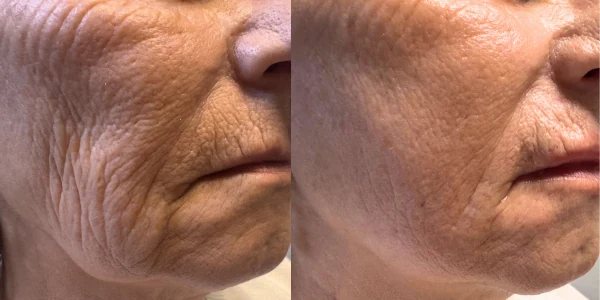
Microneedling and laser treatments done within the skin can prompt your own fibroblasts to start a repair response. Some add-on treatments may also support that repair. Each one works at a different depth and in a different way. The goal is the same: healthier, more resilient skin.
- Microneedling with SkinPen. Tiny, controlled channels in the skin activate repair signals and new collagen formation. No heat is used. It is often chosen for texture, fine lines, pores and selected scars.
- ProDeep laser. This non-ablative laser heats deeper skin without removing the surface. That heat supports deeper collagen remodeling, with less surface disruption and typically less downtime.
- DualMode laser. This laser has both ablative and non-ablative settings. It is used for stronger resurfacing, texture correction and renewal. Stronger correction comes with more recovery planning.
- PRP. PRP and selected regenerative treatments may also support tissue signaling and recovery when clinically appropriate.
Results vary. Microneedling and laser treatments are done at our Sarasota clinic.
How should you plan care for changing skin?
A good plan does three things: it protects, it stimulates and it restores.
- Protect. Preserve the collagen you have and reduce further damage. Daily sun protection is the foundation. In a four-and-a-half-year randomized trial of adults under 55, the group that used sunscreen every day was 24% less likely to show more skin aging than the group that used it when they chose to. (Hughes and colleagues, Annals of Internal Medicine, 2013.) Medical-grade skin care supports this daily work.
- Stimulate. Activate the skin’s natural remodeling response, with treatments like microneedling or laser.
- Restore. Address movement, volume or support that remodeling cannot replace. For lines from muscle movement, that may mean wrinkle relaxers. For lost volume, it may mean dermal filler.
Earlier planning does not mean doing more. It often means preserving more of what you have and choosing treatment more intentionally over time.
Antje Dangel, PA-C, our Clinical Director, puts it this way: “My goal is not to recommend the most treatment. It is to identify what is changing, determine which layer needs attention, and build a plan that remains appropriate as your skin evolves.”
Why look at skin as part of a whole-person plan?
Many of the things that speed up collagen loss, like sleep, hormone shifts and overall health, sit outside the skin. Healthy aging connects how you look, feel, function and live over time.
At Eternal MedSpa, we think of it as three connected priorities:
- Look Better: skin health, balance and confidence.
- Feel Better: wellness, hormones and recovery.
- Live Better: metabolic health, strength and function.
Together, they help you age better, as one medically guided plan built around the whole person. A good first step is a consultation. Tell us what you are noticing, and we will help you find the right treatment depth, order and starting point.
Collagen loss: common questions.
Can collagen loss start before you see wrinkles?
Yes. Thinner skin, less firmness, larger-looking pores, uneven texture and dullness can all show up before deeper wrinkles appear.
What is the difference between collagen and elastin?
Collagen gives skin strength and structure, while elastin gives it flexibility and recoil. Collagen holds skin up, and elastin helps it spring back after it moves.
What does hyaluronic acid do in your skin?
Hyaluronic acid binds and holds water. That helps keep skin hydrated and resilient.
Do collagen supplements work?
They may offer nutritional support, but they do not rebuild collagen in a specific spot. Digestion breaks oral collagen into peptides and amino acids, and studies suggest only modest gains in hydration or elasticity for some people.
Is microneedling or laser better for collagen?
Neither is right for everyone, because they work at different depths and in different ways. Microneedling uses tiny channels without heat, ProDeep heats deeper skin without removing the surface, and DualMode offers stronger resurfacing with more recovery planning. Your provider matches the treatment to your skin and your goals.
Is it too early to plan if I do not have wrinkles yet?
No. Earlier planning does not mean doing more; it often means protecting more of what you have, starting with daily sun protection.
Sources.
- Papakonstantinou E, Roth M, Karakiulakis G. Hyaluronic acid: a key molecule in skin aging. Dermato-Endocrinology. 2012.
- Varani J, et al. Decreased collagen production in chronologically aged skin: roles of age-dependent alteration in fibroblast function and defective mechanical stimulation. American Journal of Pathology. 2006.
- Fisher GJ, et al. Pathophysiology of premature skin aging induced by ultraviolet light. New England Journal of Medicine. 1997.
- Hughes MCB, Williams GM, Baker P, Green AC. Sunscreen and prevention of skin aging: a randomized trial. Annals of Internal Medicine. 2013.
More articles. From our Knowledge Center.


Book your consultation.
Every plan starts with a complimentary consultation.
Reserve your visit in Sarasota or Venice. Prefer to text first? Text us at 941-337-8461.
Still deciding? Try the Eternal Plan Builder.
Please give 24 hours' notice to cancel or reschedule. Cancellation policy
Educational content only. This article does not diagnose, prescribe, determine candidacy, or replace evaluation by an appropriately licensed healthcare provider. Treatment plans depend on health history, goals, and provider assessment. Individual results vary.