 Best of Sarasota 2026 Gold

How Does Microneedling Work? The Science of Controlled Injury
Medically reviewed


Making thousands of tiny injuries in your skin, on purpose, sounds like the wrong way to improve it. But microneedling relies on something your body does remarkably well. It notices a small, controlled injury. It starts repair. Then it rebuilds. The procedure creates the signal. Your own biology does the repair. Here is what happens beneath the surface. Microneedling makes a controlled mechanical injury, not random damage.
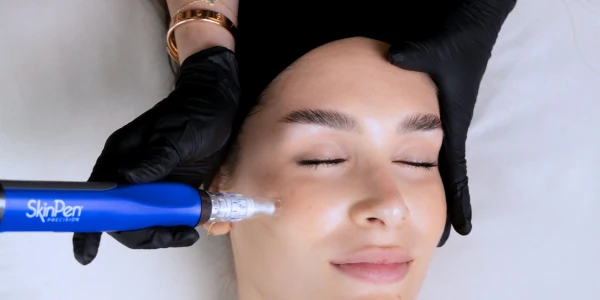
What does microneedling actually do to the skin?
Microneedling makes a controlled mechanical injury, not random damage. At Eternal MedSpa, we use the SkinPen microneedling device. Its sterile, fast-moving tiny needles create precise microchannels in the skin, to a depth set for your skin and your goals.
Many skin treatments use heat to get their effect. Microneedling does not. It uses no laser, no light and no heat. The injury is purely mechanical.
That injury is the starting signal. It tells your skin to begin its normal wound-healing response. This is why microneedling is called a collagen induction treatment: the goal is not the injury itself, but the repair that follows.
Why would an injury help your skin?
Because short-term inflammation is a normal, necessary part of healing.
Chronic or poorly controlled inflammation can harm tissue over time. Acute inflammation is different. It is short, and it is one of the body’s first steps toward repair.
Think about exercise. A hard workout puts your muscles under temporary stress. With the right recovery, your body repairs and adapts. Microneedling follows the same broad idea: controlled stress, then repair and adaptation. The biology underneath is different, but the principle is similar.
What happens beneath the surface after microneedling?
Your skin moves through overlapping phases of wound healing. Researchers often list an immediate first step, called hemostasis, when platelets gather and help seal the injury. After that come three phases that blend into one another rather than switch on and off.
Phase 1: Inflammation
Platelets, immune cells and signaling molecules respond to the micro-injury. They clear the area and send out chemical messages that call in repair cells.
Phase 2: Proliferation
Fibroblasts and other repair cells become more and more active. Fibroblasts are the cells that make collagen, the protein that gives skin its firmness and smooth texture. In this phase, they begin laying down new collagen and other support fibers.
Phase 3: Remodeling
The extracellular matrix is produced, reorganized and matured. That matrix is the support network between your skin cells, and collagen is a major part of it. Over the following months, this new tissue is reorganized and strengthened.
Together, these phases turn a small, short injury into a much longer rebuilding process.
Why do microneedling results take time?
Because the microchannels close quickly, but the remodeling they start lasts much longer. The visible signs of treatment fade. The rebuilding underneath keeps going.
One treatment can start that response. For many guests, a series of treatments, spaced the right distance apart, gives the skin repeated chances to remodel a little more each time. That is why change often builds gradually, over weeks to months. It is also why acne scars and texture are commonly treated as a series.
Is deeper or more aggressive microneedling better?
Not necessarily. More aggressive is not automatically better.
The right depth, the time between sessions and the number of sessions should reflect several things:
- Anatomy. Different areas of the face and neck have different skin.
- The concern. A scar is not the same as a fine line.
- Your skin. Thickness, sensitivity and history all matter.
- Your goals, and how your skin responds to each session.
Recovery is part of the treatment. Healing is where the remodeling happens. Treating harder, or treating again too soon, cuts into the time your skin needs to rebuild.
What do PRP, HA and exosomes add to microneedling?
They are optional add-ons that aim to support the environment where your skin’s natural repair happens. SkinPen stands on its own, and we add one only when your concern and plan support it.
PRP with HA
PRP, or platelet-rich plasma, is prepared from a small sample of your own blood. It contains concentrated platelets and the signaling factors that come with them. Because it comes from your blood, it needs a blood draw and a candidacy review. HA, or hyaluronic acid, is a substance your skin makes naturally. It holds water and supports hydration and the space between cells.
Exosome-based add-ons
Exosomes are tiny bubbles that cells release to send signals to one another. At Eternal, an exosome product is applied to the skin after treatment. It is never injected. Its possible role in recovery and tissue remodeling is still being studied. Exosome-based skin products are an evolving area of research, and they are not used to diagnose, treat or prevent disease.
Different approaches, same idea: support the conditions in which your skin repairs itself.
How is microneedling different from laser resurfacing?
Microneedling makes a mechanical micro-injury, while more aggressive ablative resurfacing relies on heat to remove thin layers of skin. That difference shapes recovery.
For many guests, microneedling means a relatively short recovery. A review of the research in Dermatologic Surgery described microneedling as having a short recovery and limited side effects. The authors called it a valuable alternative to laser resurfacing and deep chemical peels for some concerns.
Stronger resurfacing, such as our DualMode laser, comes with more downtime to plan for. ProDeep is a non-ablative laser option for collagen support.
What is recovery like after microneedling?
Recovery is usually short, but your skin does need care while it heals. Temporary redness, sensitivity, tightness, dryness or mild swelling can occur. How long it lasts depends on treatment intensity and how your skin responds.
While you heal:
- Protect your skin from the sun. Diligent sun protection is essential.
- Leave it alone. Do not pick, scrub or aggressively exfoliate healing skin.
- Follow your aftercare. Use only the products our medical team approves, and avoid harsh actives until you are cleared.
Before treatment, tell us about recent isotretinoin use, cold sores, keloids, medications that affect healing, or pregnancy or breastfeeding.
What can microneedling help, and what can’t it do?
Microneedling can help certain concerns involving skin texture, the appearance of acne scars, fine lines and overall skin quality. But aging does not happen through one mechanism, so no single tool addresses everything.
Microneedling cannot promise scar removal, pore elimination or wrinkle correction. Color concerns, such as pigment, redness and visible blood vessels, are usually a question for IPL treatment.
Some concerns need a different mechanism entirely. Radiesse, for example, is made of calcium hydroxylapatite (CaHA). Used as a filler, it adds structure. Over time, CaHA can also stimulate collagen and elastin production. Different mechanism, different purpose.
How does Eternal MedSpa plan microneedling?
We start by identifying what has changed in your skin. Then we decide which treatment, or which combination and order of treatments, makes sense.
Healthy aging is not about collecting procedures. It is about understanding the biology and building a thoughtful, medically guided plan around it.
SkinPen microneedling is offered at our Sarasota clinic only. Alexa Martinez of our medical team performs it, under the oversight of a board-certified medical director. Your plan starts with a complimentary consultation, where we review your skin, your history, your goals and how much downtime fits your life. Medical-grade skin care and sun protection between visits are part of the plan.
How microneedling works: common questions.
How does microneedling work?
It makes tiny, controlled injuries in the skin without heat, which start the skin’s normal wound-healing response. Over the following months, that response produces and reorganizes collagen and other support fibers.
Does microneedling use heat like a laser?
No. Microneedling creates a mechanical micro-injury with tiny needles, not heat, which is one reason recovery is often relatively short.
How many microneedling treatments will I need?
It depends on your concern, your skin and how you respond. Acne scars and texture are commonly treated as a series, and well-spaced sessions give the skin repeated chances to remodel.
When will I see results from microneedling?
Gradually. The microchannels close quickly, but remodeling continues for months, so visible change may build over weeks to months.
What is recovery like after microneedling?
It is usually short, with temporary redness, sensitivity, tightness, dryness or mild swelling. Diligent sun protection is essential while your skin heals.
Do I need PRP or exosomes with microneedling?
No. SkinPen stands on its own, and PRP or exosomes are added only when your concern and plan support it.
Sources.
- Guo S, DiPietro LA. Factors affecting wound healing. Journal of Dental Research. 2010. doi:10.1177/0022034509359125.
- Alster TS, Graham PM. Microneedling: a review and practical guide. Dermatologic Surgery. 2018. doi:10.1097/DSS.0000000000001248.
More articles. From our Knowledge Center.

Book your consultation.
Every plan starts with a complimentary consultation.
Reserve your visit in Sarasota or Venice. Prefer to text first? Text us at 941-337-8461.
Still deciding? Try the Eternal Plan Builder.
Please give 24 hours' notice to cancel or reschedule. Cancellation policy
Educational content only. This article does not diagnose, prescribe, determine candidacy, or replace evaluation by an appropriately licensed healthcare provider. Treatment plans depend on health history, goals, and provider assessment. Individual results vary.