 Best of Sarasota 2026 Gold

Why Do Collagen Treatments Take Months to Show Results?
Medically reviewed

Nobody goes to the gym once and expects a new body. We know muscle takes months of steady work. Yet with skin, many of us expect the full result in the mirror the next morning. Some treatments do work that fast. But the treatments that change your skin the most are often the ones you can’t see working at first. Here is why, what is happening under the skin, and how to judge a treatment that takes its time.

What is the difference between a fast and a slow treatment?
A fast treatment does the work for you, so you see it soon. A slow treatment sends your skin a signal, and your body does the work over months.
Both give real, useful results. They just do different jobs. Fast treatments change how your face looks now. Slow treatments change the skin itself, by helping it build more of its own support.
Neither one is better. A good plan often uses both: one for now, one for later.
How do wrinkle relaxers and filler work so quickly?
They work quickly because they act directly. They don’t wait for your skin to rebuild anything.
A wrinkle relaxer quiets the signal from a nerve to a targeted muscle. With less signal, the muscle tightens less, and the line it makes softens. Change usually starts within a few days, and the full effect is judged at about two weeks. Then it wears off gradually. Results last two to four months, often about 90 days, and it depends on the person.
Dermal filler is a gel placed under the skin. It fills space, so it shows right away. Depending on the product, it lasts for months to a year or more.
Both need upkeep, because the effect fades over time.
How do slow treatments build collagen?
Slow treatments work by starting your skin’s own repair process. That process builds new collagen, and it takes months.
Collagen is the protein that keeps skin firm. Elastin is a partner protein that helps skin spring back. Both decline with age. The cells that make them are called fibroblasts.
Slow treatments give fibroblasts a reason to get to work. The signal differs by treatment:
- Biostimulators place tiny particles under the skin. Your body responds by forming new collagen around them.
- Microneedling makes thousands of tiny, controlled channels in the skin, without heat.
- Laser uses controlled heat. ProDeep heats deep columns of skin and leaves the surface in place. DualMode can also remove damaged surface skin for stronger resurfacing.
With microneedling and laser, the skin answers in stages. First comes short-term inflammation, which is the swelling you see. Then fibroblasts become active and lay down new collagen. That new collagen keeps forming for months.
What you gain is your own tissue. A treatment can start the process. It cannot rush it.
Why does a biostimulator look like it wore off?
It can look like the result left because the early fullness is partly swelling plus the gel or water that carries the product. The collagen comes later.
Biostimulators such as Radiesse and Sculptra are the clearest example. Radiesse is made of tiny, smooth spheres of calcium hydroxylapatite, a mineral also found in bones and teeth, mixed into a soft gel. Sculptra is made of poly-L-lactic acid, a material the body breaks down over time. Its tiny particles set off a mild, controlled response in the skin that leads to new collagen. Neither is a one-and-done treatment.
Here is how the timeline usually goes:
- Day one: the preview. It looks great. Part of that is swelling, plus the water or gel that carries the product. It is a preview, not the final result.
- Days to weeks: the dip. Swelling settles. With Sculptra, the water is absorbed within a few days. With Radiesse, the gel is absorbed over the next several weeks, often two to three months. This is when people worry it didn’t stick. It did. The work has just begun.
- The following months: the build. Your skin forms new collagen around the product. With Radiesse, this can begin at about four weeks. A small study that looked at treated skin under a microscope found new collagen forming around the Radiesse spheres.
- A year or more: the result. Radiesse commonly lasts a year or more. Sculptra is usually given as a series of about three sessions, and results can last up to about two years.
What happens under the skin after microneedling or laser?
After microneedling or laser, your skin swells for a few days while it heals. Then it spends months building collagen underneath.
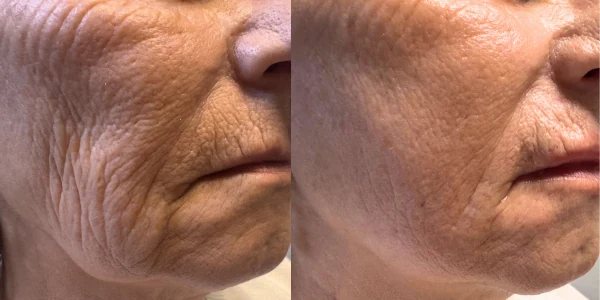
That early swelling can make skin look plumper and smoother. When it settles, you may wonder what changed. But the real work is just starting. After microneedling, new collagen keeps forming for about three to six months. After ProDeep laser, collagen changes take at least three months to show and can keep building after that. Full results usually take several months.
That is why microneedling is done as a series, a few weeks apart. Each session builds on the last one, like each workout. Microneedling has been studied for years. A 2008 study of 480 people treated this way for scars, wrinkles and loose skin reported improvement in those concerns.
Laser and microneedling are offered at our Sarasota clinic.
Why is the gym a good way to think about it?
The gym is a good comparison because the change you see right after a workout is not the real result. The real result comes later, built quietly while you rest.
After a hard workout, your muscles look bigger for a short while. Lifters call it the pump. Then it fades. The pump was never the result. Muscle is built over months, and only if you keep going back. Some people work at it for years and never stop.
Collagen works the same way. The swelling after a treatment is the pump. The collagen that forms over the next months is the muscle.
How should you judge a slow treatment?
Judge a slow treatment by your photos at three months, not by the mirror at three days.
- Take a photo before you start. Use the same light and angle each time. Compare at three months, not three days.
- Finish the series. Stopping after one session is like quitting the gym after one workout.
- Start before you need it. A good time to begin is a few months before you want to see the result.
- Ask us two questions. When will I see it? How many sessions will I need? We will tell you honestly what is fast, what is slow, and what is worth the wait.
“I would rather tell you the truth about timing than promise you a quick fix,” says Antje Dangel, PA-C. “My favorite visit is the one at three months, when someone looks in the mirror and says, now I see it.”
Collagen treatments: common questions.
Why do collagen treatments take so long to work?
Because your body is building new tissue, and collagen forms slowly over months. The treatment starts the process, but it cannot rush it.
Is it normal for a biostimulator to look like it wore off after a few weeks?
Yes, an early dip is common with biostimulators such as Radiesse and Sculptra. The first fullness is partly swelling and the gel or water that carries the product, and the collagen that gives the lasting result builds over the following months.
How long until I see results from microneedling?
Full results usually take several months, because new collagen keeps forming for about three to six months after treatment. That is why microneedling is usually done as a series, a few weeks apart.
Are fast treatments or slow treatments better?
Neither is better, because they do different jobs. Wrinkle relaxers and filler change how you look now, and slow treatments help your skin build its own collagen for later, so a good plan often uses both.
When should I start a collagen treatment before an event?
Start a few months before you want to see the result. Collagen takes months to build, and many of these treatments are done as a series.
How do I know if a slow treatment is working?
Compare a photo taken before you start with one taken at three months, in the same light and angle. Collagen changes are gradual, so they are easier to see in photos than in the mirror day to day.
Sources.
- Fitzgerald R, Bass LM, Goldberg DJ, Graivier MH, Lorenc ZP. Physiochemical characteristics of poly-L-lactic acid (PLLA). Aesthetic Surgery Journal. 2018.
- Berlin AL, Hussain M, Goldberg DJ. Calcium hydroxylapatite filler for facial rejuvenation: a histologic and immunohistochemical analysis. Dermatologic Surgery. 2008.
- Aust MC, Fernandes D, Kolokythas P, et al. Percutaneous collagen induction therapy: an alternative treatment for scars, wrinkles, and skin laxity. Plastic and Reconstructive Surgery. 2008.
More articles. From our Knowledge Center.


Book your consultation.
Every plan starts with a complimentary consultation.
Reserve your visit in Sarasota or Venice. Prefer to text first? Text us at 941-337-8461.
Still deciding? Try the Eternal Plan Builder.
Please give 24 hours' notice to cancel or reschedule. Cancellation policy
Educational content only. This article does not diagnose, prescribe, determine candidacy, or replace evaluation by an appropriately licensed healthcare provider. Treatment plans depend on health history, goals, and provider assessment. Individual results vary.